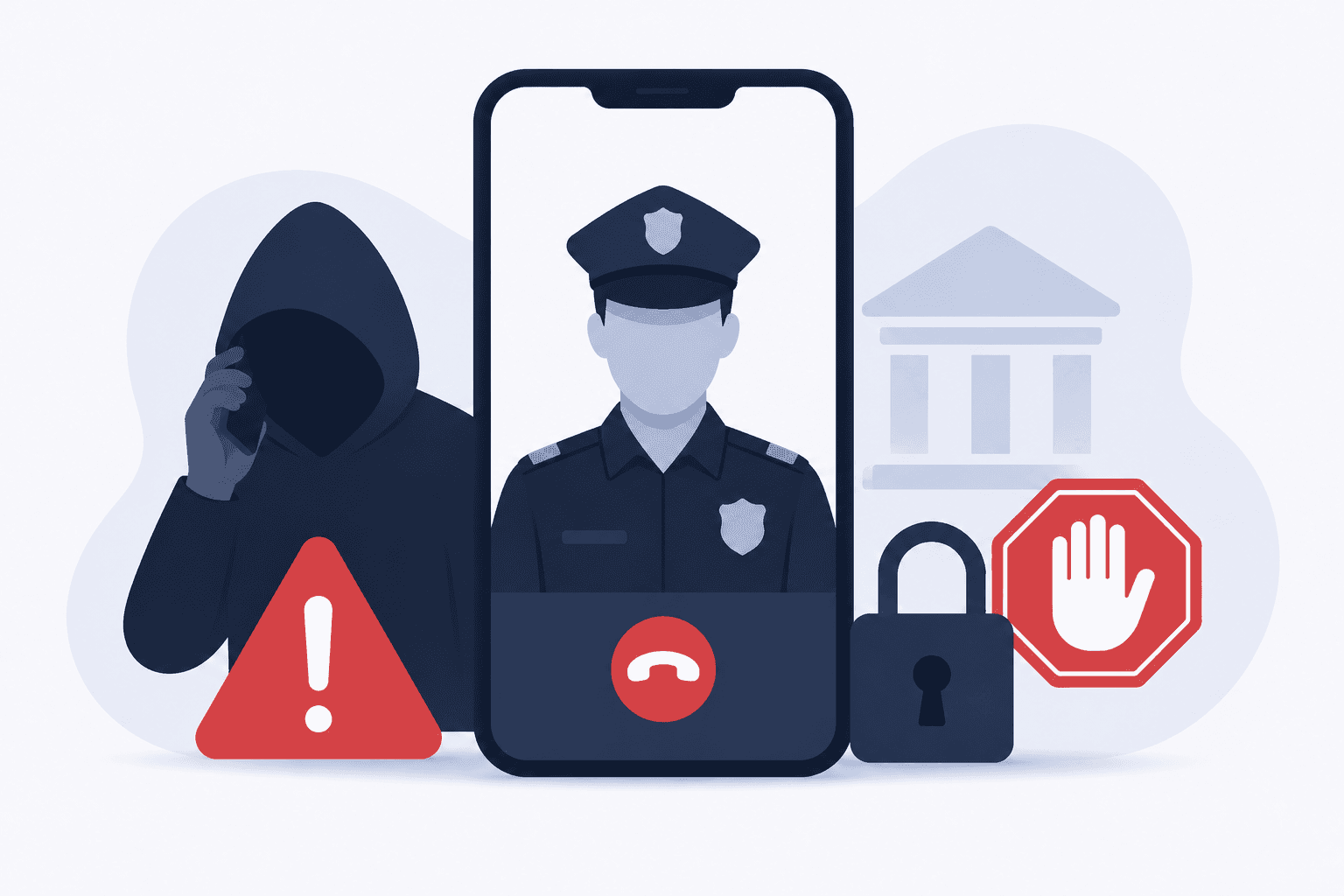
A phone call arrives from someone claiming to be from the police, CBI, customs, a courier company or another government agency. They know your name. They sound authoritative. They say you are connected to a serious crime. Then comes the threat: cooperate immediately, transfer money, or face arrest.
This is the anatomy of one of India's most intimidating forms of cyber fraud — the digital arrest scam.
Unlike many online scams that begin with an obviously suspicious link or message, digital arrest scams are built around psychological pressure. Fraudsters impersonate officials, fabricate criminal cases, use video calls and fake documents, and attempt to keep victims isolated long enough to extract money.
The scam can feel frighteningly real.
But the central premise is false.
A criminal cannot legitimately place someone under a so-called “digital arrest” over a phone or video call and demand money to clear their name.
Understanding how these scams unfold is one of the best ways to avoid becoming a victim.
What exactly is a digital arrest scam?
A digital arrest scam is a form of impersonation and social-engineering fraud in which criminals pretend to represent law-enforcement agencies, investigative bodies, government departments, banks, telecom companies, customs authorities or courier services.
The victim is falsely accused of involvement in serious illegal activity.
The allegation could involve money laundering, drugs, illegal parcels, suspicious bank accounts, identity theft or misuse of Aadhaar, PAN, SIM cards or other personal information.
The objective is not necessarily to make the story legally convincing.
It is to make the victim afraid enough to stop questioning it.
Once fear takes over, the scammers begin issuing instructions.
It may begin with an ordinary phone call
A typical digital arrest scam may start with something that initially appears unrelated to law enforcement.
A caller might claim to represent a courier company.
They tell you that a parcel registered under your name has been intercepted.
The parcel supposedly contains illegal drugs, fake passports, suspicious documents or prohibited items.
You naturally respond:
“I never sent that parcel.”
That is when the scam escalates.
The caller says the matter is serious and needs to be reported immediately. Your call is supposedly transferred to the “police”, “cybercrime department”, “customs”, “CBI” or another authority.
A second person joins.
Their tone is different.
More authoritative.
More aggressive.
They may give you a fake officer's name, badge number, case number or police-station details.
And suddenly, what started as a courier problem becomes a criminal investigation.
“Your Aadhaar has been used in a crime”
Another common version begins with identity misuse.
The caller claims that a bank account, SIM card, parcel or financial transaction associated with your identity has been connected to criminal activity.
They might say:
“A bank account opened using your Aadhaar has been used for money laundering.”
Or:
“Your mobile number is connected to illegal transactions.”
Or:
“A parcel containing narcotics has been registered using your identity.”
The allegations are deliberately serious.
Money laundering.
Drug trafficking.
Cybercrime.
Illegal international transfers.
The more frightening the accusation, the more likely the victim is to panic.
Then comes the video call
This is where digital arrest scams can become particularly convincing.
The victim may be instructed to join a video call.
On screen, the fraudster may appear to be sitting inside a police station or government office.
There may be uniforms.
Official-looking logos.
Flags.
Identity cards.
Case files.
Legal documents.
Police insignia.
Other supposed officers may appear in the background.
The entire environment may be staged.
Modern digital manipulation and AI tools can make impersonation attempts even more convincing, which makes independent verification increasingly important.
The victim sees something that looks official and begins to believe the threat is real.
But visual appearance is not proof of authority.
The real weapon is fear
Digital arrest scams are fundamentally psychological attacks.
The scammers want to create an environment where the victim feels they have no time to think.
They may say:
“Do not disconnect this call.”
“Do not tell your family.”
“This investigation is confidential.”
“Your accounts are being monitored.”
“If you disconnect, police will arrive at your house.”
“You are under surveillance.”
“An arrest warrant has been issued.”
The objective is isolation.
If the victim speaks to a family member, lawyer, bank employee, police officer or trusted friend, the scam could collapse immediately.
So the fraudster tries to become the victim's only source of information.
This is one of the biggest warning signs.
Legitimate authorities do not need to isolate you from everyone around you to prove their legitimacy.
Why scammers keep victims on video calls
Some victims may be kept connected for extended periods.
This serves several purposes.
First, it prevents the victim from independently calling someone else.
Second, it allows the scammers to continuously reinforce the threat.
Third, prolonged pressure can exhaust the victim mentally.
A person who has been frightened and interrogated for hours may eventually comply with instructions they would normally recognise as suspicious.
This is not sophisticated hacking.
It is psychological manipulation conducted through technology.
Then the conversation turns to money
Eventually, the fake investigation creates a reason for the victim to transfer funds.
The terminology varies.
The scammers may call it:
Account verification.
Fund verification.
Security deposit.
Temporary investigation account.
Financial verification.
RBI verification.
Safe account transfer.
The victim may be told that their money needs to be transferred temporarily while authorities verify that it is legitimate.
They may even be promised:
“The money will be returned once verification is complete.”
That is the trap.
Money transferred to these accounts may quickly be moved through multiple accounts, payment systems or other channels, making recovery difficult.
No legitimate investigation requires you to prove your innocence by transferring your savings to an unknown account over a phone or video call.
Fake documents make the scam feel real
Digital arrest scammers may send documents through WhatsApp, email or other messaging platforms.
These can include supposed:
Arrest warrants
Court notices
Police complaints
Confidentiality orders
Investigation notices
Government letters
Bank-freezing orders
Identity cards
The documents may contain government logos, signatures, stamps and official-looking formatting.
But a professional-looking PDF does not prove authenticity.
Logos can be copied.
Signatures can be fabricated.
Documents can be created in minutes.
The existence of a document should never replace independent verification.
The scammer knows information about me. Doesn't that mean they're genuine?
No.
This is one of the reasons modern scams can be so convincing.
Fraudsters may already know information such as your:
Full name
Phone number
Email address
Address
Employer
Family information
Previous transactions
Online activity
Some information may come from leaked databases, compromised accounts, publicly available sources, social media or earlier phishing attempts.
A scammer mentioning your name, Aadhaar-related information, bank name or another personal detail does not automatically prove that they represent a legitimate authority.
Personal information should not be treated as authentication.
How to recognise a digital arrest scam
Several warning signs appear repeatedly.
Be extremely cautious if someone claiming to represent an authority threatens immediate arrest through a phone or video call and simultaneously demands money.
The risk becomes even clearer if they tell you not to disconnect, prevent you from speaking with family, demand secrecy or ask you to move money to a supposedly “safe” or “verification” account.
Requests for OTPs, banking credentials, UPI PINs or screen-sharing access are additional warning signs.
Another major red flag is manufactured urgency.
Real legal processes involve procedures, documentation and opportunities for verification.
A caller screaming that you must transfer money within minutes should not be treated as proof of a legitimate investigation.
What should you do if you receive a digital arrest call?
The safest response is often surprisingly simple:
Disconnect.
You do not need the caller's permission to end the conversation.
Do not argue with them.
Do not attempt to prove your innocence.
Do not transfer money.
Do not share an OTP.
Do not reveal banking credentials.
Do not install an application.
Do not enable screen sharing.
Do not allow the caller to keep you isolated.
Once disconnected, independently verify the claim.
If the caller claimed to represent a particular police department, bank, courier company or government organisation, obtain the organisation's contact information from an official source.
Do not call a number supplied by the suspicious caller.
If the allegation is genuinely serious, you can contact the appropriate authority independently or seek qualified legal assistance.
What if they threaten to arrest me for disconnecting?
That threat is designed to keep you inside the scam.
Fear creates compliance.
The scammer understands that if you disconnect and speak with another person, you may quickly realise what is happening.
That is precisely why they don't want you to hang up.
Remember:
A threat becoming more aggressive when you try to verify it independently is itself a major warning sign.
What if you have already transferred money?
Act quickly.
Contact your bank or payment provider through official channels and report the fraudulent transaction immediately.
In India, suspected cyber financial fraud can be reported through the government's cybercrime reporting system, including the 1930 cybercrime helpline and the National Cyber Crime Reporting Portal.
Preserve all available evidence.
Do not delete the WhatsApp conversation, phone number or video-call details simply because you are embarrassed or frightened.
Save relevant:
Screenshots
Phone numbers
Bank-account information
UPI IDs
Transaction IDs
Payment receipts
WhatsApp conversations
Emails
Documents sent by the scammers
Website links
Call records
This information may help banks and authorities investigate the incident.
If sensitive passwords or credentials were exposed, secure the affected accounts immediately.
Why intelligent people still fall for digital arrest scams
Victims of these scams are not necessarily careless or technologically inexperienced.
The attack is specifically designed to prevent rational decision-making.
Imagine suddenly being told that your identity has been connected to drug trafficking or money laundering.
A supposed police officer appears on video.
They know your name.
They show you a document bearing government insignia.
They threaten arrest.
They tell you not to contact anyone.
Then they demand an immediate decision.
The victim isn't making a normal financial decision anymore.
They are responding to a manufactured emergency.
That distinction matters.
Cybersecurity education should therefore move beyond telling people simply to “be careful”.
People need to understand how scammers manipulate human behaviour.
AI could make impersonation scams harder to recognise
The next generation of digital arrest scams may become even more sophisticated.
Generative AI can potentially help criminals produce more convincing voices, images, documents, translations and impersonation attempts.
This changes an important assumption many people have relied on:
Seeing someone is not necessarily verification.
Hearing someone is not necessarily verification.
Digital trust increasingly requires independent confirmation.
If a financial or legal request is serious, verify it through another trusted channel.
A simple rule: Stop. Disconnect. Verify.
When faced with a threatening call, remember three words:
Stop.
Do not make financial decisions while frightened.
Disconnect.
End the suspicious call or video session.
Verify.
Contact the organisation independently using an official source.
The scammer wants everything to happen inside one conversation.
Your safest move is to break that environment.
ZEX: Building Security for the Age of Digital Deception
Cybersecurity is changing.
The threat is no longer limited to viruses, infected computers and malicious files.
Modern cybercrime increasingly combines technology with human manipulation.
A phone call can be an attack.
A WhatsApp conversation can be an attack.
A QR code can be an attack.
A fake identity can be an attack.
An AI-generated voice or manipulated video can potentially become an attack.
At ZEX, our vision is to build a broader digital security layer that helps individuals recognise risks across their digital lives — from suspicious links and identity exposure to risky applications, fraudulent interactions and emerging AI-powered threats.
Because the next generation of cybersecurity isn't only about asking:
“Is my device secure?”
It is also about asking:
“Can I trust the person, message or interaction in front of me?”
Digital arrest scams succeed when fear moves faster than verification.
Make verification faster.
Stop. Disconnect. Verify.
Stay aware. Stay protected. Stay ZEX Secure.
Disclaimer: This article is intended for cybersecurity awareness and educational purposes and does not constitute legal advice. Scam methods and impersonation techniques continue to evolve. If you believe you have experienced cyber financial fraud in India, immediately contact your bank or payment provider and report the incident through official government cybercrime reporting channels.