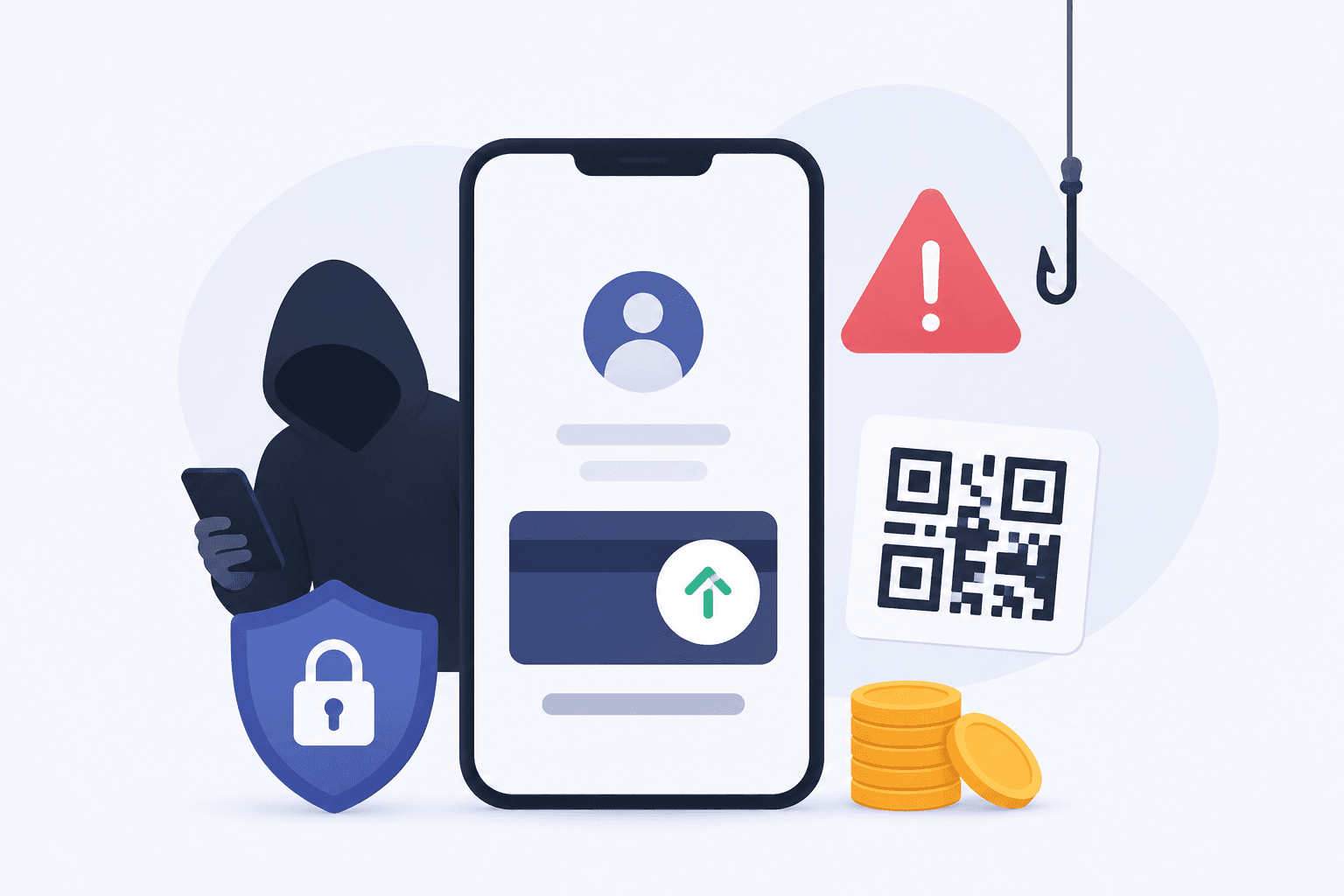
UPI Fraud in India: How Scammers Steal Your Money and How to Stay Safe
UPI has changed the way India pays.
From paying a local shopkeeper to sending money to family, booking a cab, paying bills or shopping online, a transaction can now be completed within seconds.
But the same speed and convenience that make UPI powerful have also created opportunities for cybercriminals.
And there is one important thing every UPI user needs to understand:
Most UPI scams don't require hackers to break into your bank account.
Instead, scammers try to convince you to authorise the payment yourself.
They use fake payment requests, QR codes, UPI collect requests, phishing links, screen-sharing applications and carefully designed social-engineering tactics.
Understanding how these scams work can help you recognise the warning signs before money leaves your account.
What Is UPI Fraud?
UPI fraud refers to scams or unauthorised activities involving India's Unified Payments Interface ecosystem.
The attacker may impersonate a:
Bank employee
Customer-care executive
Online buyer
Seller
Government official
Delivery agent
Recruiter
Investment adviser
Friend or relative
Their objective is usually the same:
Get you to approve something you shouldn't.
That could mean entering your UPI PIN, approving a collect request, scanning a QR code, visiting a phishing website or giving an attacker visibility into your phone.
The Most Important UPI Rule to Remember
You do not enter your UPI PIN simply to receive money.
Your UPI PIN is used to authorise transactions from your account.
If someone tells you:
“Enter your PIN to receive the refund.”
“Enter your UPI PIN to accept ₹5,000.”
“Scan this QR and enter your PIN so I can pay you.”
Stop.
You may be authorising money to leave your account instead.
Before entering your UPI PIN, always check exactly what transaction you are approving.
1. Fake Payment Request Scams
Imagine you are selling a used phone online for ₹20,000.
A buyer contacts you almost immediately.
They seem genuinely interested and agree to the price without negotiating much.
Then they say:
“I'm sending the payment through UPI.”
Moments later, something appears on your phone.
The buyer tells you:
“Just approve it and enter your PIN to receive ₹20,000.”
But instead of receiving ₹20,000, you may actually be approving a payment from your account.
This is a classic social-engineering technique.
How the scam works
The scammer creates urgency and confusion.
They may keep talking continuously so you don't carefully read what appears on your screen.
They want you to follow their instructions automatically.
How to protect yourself
When receiving money, do not blindly approve unexpected requests.
Read every payment screen carefully.
Check:
Amount
Recipient
Transaction type
UPI ID
Whether money is being sent or requested
If anything looks unusual, cancel the transaction.
2. UPI Collect Request Scams
A UPI collect request allows someone to request payment from another user.
It is a legitimate feature.
But scammers can abuse it.
Suppose someone owes you ₹2,000.
Instead of sending ₹2,000, they send you a request asking you to pay ₹2,000.
Then they call and say:
“I've sent the payment request. Just enter your PIN to receive the money.”
If you approve the request, you may send money instead.
The psychological trick
Many people assume anything appearing inside a trusted payment application must be safe.
But the application is only showing you a request.
You still need to decide whether that request is legitimate.
Never approve a collect request simply because someone tells you to.
3. QR Code Scams
QR codes have become part of everyday life in India.
We scan them at:
Shops
Restaurants
Petrol pumps
Parking facilities
Street vendors
Online marketplaces
But QR codes can also be used as part of scams.
“Scan this QR code to receive money.”
This is one of the biggest warning signs.
A scammer pretending to be a buyer may say:
“I'll send you ₹10,000. Scan this QR code first.”
The QR code may instead initiate a payment flow or take you somewhere malicious.
If you then enter your UPI PIN without carefully reading the screen, you may authorise a payment.
Remember
You generally don't need to scan somebody else's QR code simply to receive a normal UPI payment from them.
If someone wants to pay you, they can use your verified UPI details or scan your payment QR code.
4. Fake Refund Scams
Refunds are another popular excuse.
You may receive a call from someone claiming to represent:
A bank
E-commerce company
Food-delivery service
Airline
Telecom company
UPI application
Courier company
They say:
“Your refund of ₹4,999 is pending.”
Then they ask you to scan a QR code, approve a request or enter your UPI PIN.
The possibility of getting money back lowers your suspicion.
That is exactly what the scammer wants.
Protect yourself
If you are expecting a refund, verify its status through the company's official application or website.
Do not trust an unsolicited caller simply because they know your name, order details or phone number.
5. Fake Customer-Care UPI Scams
You have a problem with a transaction.
You search online:
“XYZ Bank customer care number.”
A phone number appears.
You call.
The person answers professionally:
“Yes sir, I can see your transaction problem.”
But you may have contacted a scammer.
Fraudsters may create fake websites, advertisements, social-media profiles and listings designed to impersonate legitimate customer support.
The fake executive may then ask you to:
Share an OTP
Enter your UPI PIN
Install an application
Open a link
Scan a QR code
Approve a collect request
Share your screen
Safer approach
Use customer-care information available through the organisation's official application or official website.
Do not automatically trust phone numbers found in comments, forwarded messages or unofficial pages.
6. Screen-Sharing and Remote-Access Scams
This type of UPI scam can be particularly dangerous.
A fake customer-support representative calls you.
They say:
“I need to check the problem on your phone.”
They then ask you to install a screen-sharing or remote-access application.
Once screen access is enabled, the scammer may be able to observe sensitive information displayed on your device.
Depending on the application and permissions involved, they may gain much greater access.
Why this is dangerous
Your smartphone contains enormous amounts of sensitive information:
Banking applications
UPI apps
SMS messages
Email
Personal documents
Contacts
Notifications
Giving an unknown person remote visibility or control over your phone can expose your digital life.
Golden rule
Never install remote-access or screen-sharing software because an unsolicited caller claiming to be customer support tells you to.
7. UPI Phishing Scams
You receive a message:
“Your UPI account will be blocked today. Complete KYC immediately.”
There is a link.
You open it.
The website looks almost identical to your bank or payment provider.
It asks for information such as:
Phone number
Banking details
Card information
Password
OTP
But the website is controlled by criminals.
This is phishing.
Look carefully at links
Fraudsters often create domain names designed to resemble legitimate organisations.
A website can have:
A professional design
Company logo
Security icons
Customer-support numbers
Even HTTPS
and still be fraudulent.
Instead of opening an unexpected KYC or banking link, open the official application yourself.
8. Small Payment Verification Scams
The scammer says:
“Send ₹1 to verify your account.”
Because the amount is tiny, the request seems harmless.
But the ₹1 isn't necessarily the real objective.
The scammer may be trying to establish trust, manipulate you into following a sequence of instructions or move you toward a larger fraudulent transaction.
Think beyond the amount
When someone you don't know asks you to perform an unusual financial action, ask:
Why is this actually necessary?
Do not let a small amount make an unusual request appear automatically safe.
9. Fake UPI Payment Screenshot Scams
Not every UPI scam steals money directly from your account.
Some scammers simply convince you that they have paid.
This commonly affects:
Shopkeepers
Small businesses
Online sellers
Delivery workers
Individuals selling products
A buyer shows a screenshot:
Payment Successful – ₹8,500
But the screenshot may be fake, edited or copied from another transaction.
The seller hands over the product without checking their actual account.
Never rely solely on screenshots
Verify payment through:
Your own UPI application
Your bank account
Your merchant payment system
A screenshot is not proof that money reached your account.
10. Social Engineering: The Real Weapon Behind UPI Fraud
Many UPI scams are fundamentally psychological attacks.
The scammer doesn't need to defeat encryption.
They need to defeat your judgement.
Cybercriminals commonly exploit six emotions:
Fear
“Your bank account will be blocked.”
Urgency
“You have five minutes to complete verification.”
Authority
“I'm calling from your bank.”
Greed
“You've won ₹50,000.”
Trust
“I'm calling from customer support.”
Confusion
“Just follow exactly what I'm telling you.”
The scammer wants you to stop analysing and start reacting.
A Typical UPI Scam in 60 Seconds
Consider this scenario.
You list a product online for ₹15,000.
Within minutes, someone calls.
They say:
“I'll buy it. No negotiation.”
Then:
“I'm sending you the payment now.”
You receive a request.
They continue speaking rapidly:
“Open it.”
“Click approve.”
“Enter your PIN.”
“Don't cancel it.”
You are excited about completing the sale and distracted by the caller.
You enter your UPI PIN.
₹15,000 leaves your account.
The entire scam may take less than a minute.
What actually happened?
The scammer combined:
Trust + urgency + distraction + misunderstanding of UPI.
That combination can be more effective than sophisticated malware.
7 Warning Signs of a UPI Scam
Be suspicious when someone:
Asks you to enter your UPI PIN to receive money.
Sends an unexpected collect request.
Asks you to scan their QR code to receive payment.
Requests your OTP, PIN or banking password.
Asks you to install a screen-sharing application.
Creates extreme urgency or threatens account suspension.
Insists that you follow instructions without reading what's displayed on your phone.
One warning sign may be enough reason to stop and verify.
The ZEX 10-Second UPI Safety Check
Before approving any unexpected UPI transaction, take ten seconds.
STOP
Don't let the caller rush you.
CHECK
Look at the amount, recipient and transaction type.
VERIFY
Confirm the person's identity independently.
READ
Read exactly what the payment application says.
AUTHORISE
Enter your UPI PIN only when you understand and intend to make that transaction.
Think of your UPI PIN as the final approval button for your money.
What Should You Never Share?
Regardless of how convincing someone sounds, treat these as highly sensitive:
UPI PIN
OTP
Debit/credit card PIN
CVV
Banking password
Verification codes
Someone knowing your name, bank, phone number or recent transaction details does not automatically prove they are legitimate.
What to Do If You Have Been Scammed Through UPI
If money has already been transferred, acting quickly matters.
1. Contact your bank or payment provider
Report the transaction immediately through official channels.
Provide the transaction ID, amount, recipient information and other relevant details.
2. Report financial cyber fraud
In India, suspected cyber financial fraud can be reported through the National Cyber Crime Reporting Portal and the 1930 cybercrime helpline.
The sooner you report the incident, the better.
3. Secure your accounts
If credentials may have been exposed, change relevant passwords immediately.
Start with:
Primary email
Banking
Payment applications
Important online accounts
4. Remove suspicious applications
If the scam involved installing an APK, remote-access tool or suspicious application, stop using it and review the device carefully.
Check permissions such as:
Accessibility
SMS
Notifications
Screen sharing
Device administration
Seek qualified technical assistance if you suspect the device remains compromised.
5. Preserve evidence
Keep:
Screenshots
UPI IDs
Phone numbers
Transaction IDs
QR codes
Chat messages
Website links
Payment receipts
Call details
These may be useful when reporting the fraud.
Why Awareness Alone Isn't Enough
The problem with cyber fraud is that people don't encounter scams only when they are calm and focused.
Scams arrive while you're:
Working.
Travelling.
Shopping.
Talking to customers.
Waiting for a refund.
Dealing with a banking issue.
Or responding to an emergency.
Even people who understand cybersecurity can make mistakes under pressure.
This is why the future of consumer cybersecurity needs to combine human awareness with intelligent technology.
How ZEX Envisions Safer Digital Payments
At ZEX, we believe digital security should work around the user rather than expecting every individual to become a cybersecurity expert.
Our broader vision for personal cybersecurity is to help users recognise suspicious digital interactions before they become costly incidents.
That means building security around the environments where modern scams happen — suspicious links, risky applications, identity exposure, unsafe networks, fraudulent communication and other digital threats.
Because the future of cybersecurity isn't only about detecting malware.
It is about helping people answer one critical question:
“Can I trust what is happening on my screen?”
One Rule Can Prevent Many UPI Scams
If you remember only one thing from this article, remember this:
Never enter your UPI PIN because someone tells you that doing so will make you receive money.
Read before you approve.
Verify before you trust.
And never allow urgency to make financial decisions for you.
Stop. Check. Verify.
Stay aware. Stay protected. Stay ZEX Secure.
Disclaimer: This article is intended for cybersecurity awareness and educational purposes. Fraud techniques evolve continuously, and the examples above are not exhaustive. If you suspect cyber financial fraud in India, contact your bank/payment provider immediately and report the incident through official government cybercrime reporting channels.